
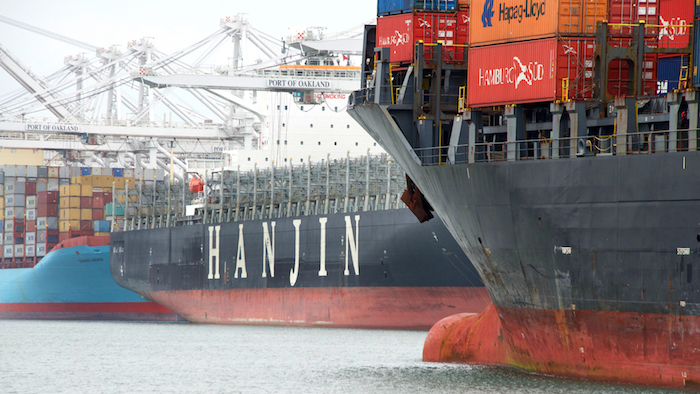
 The Hanjin Jungil unloaded its cargo at the Port of Oakland on Sept. 26
after the company declared bankruptcy on Aug. 31.
Photo credit: Sheila Fitzgerald / Shutterstock.com
The companies, in court papers filed in US Bankruptcy District Court in New Jersey, argue that a plan filed by the carrier seeking approval for Chapter 15 status impairs or even “eliminates” their rights. The Chapter 15 case, which was filed Sept. 2, will be heard by Judge John K. Sherwood in Newark, New Jersey, on Tuesday.
A separate filing by Terminal Investment Ltd., Hanjin’s partner in a company that operates two US terminals, argues that the investor’s right to acquire the assets of the joint company if the carrier wants to sell could be hurt if the US court backs the Hanjin plan.
The filings are the latest of dozens of claims filed with the court by terminals, beneficial cargo owners, logistics companies, creditors, and others seeking to mitigate the impact of the collapse of the world’s then-seventh largest carrier. The bankruptcy left more than 90 Hanjin ships and 500,000 containers around the world in limbo as the company searched for money to pay for unloading costs, and claimants sought court help in releasing cargo and equipment, and securing payment from the carrier.
US court recognition of the South Korean case, and the granting of Chapter 15 status, would enable the carrier to take certain actions in the United States to move the case along. The long-term impact, however, may be minimal, if — as some analysts believe will happen — the company is eventually liquidated.
The complainants are not seeking to derail Hanjin’s Chapter 15 plan, but to modify it — or create a “carve out” — to protect their interests.
The logistics companies, SeaCube Containers, of California, Trac Intermodal, of New Jersey, and Ocean Connect Marine, with offices worldwide, say they each signed leases to provide services to Hanjin, in many cases for containers or chassis, which the carrier terminated when it filed for bankruptcy.
However, Hanjin continued to use the equipment, and complete shipments with it, the logistics companies claim. And they want the court to ensure that the final Chapter 15 plan, if approved, does not restrict their rights to seek payment for the use of the equipment.
In particular they oppose a section of the proposed final order submitted by Hanjin’s lawyers that, among other things, prevents certain claimants from taking legal action to pursue their claims, including “judicial, quasi judicial, administrative, arbitral, or other action” to recover a claim for “unpaid judgments, settlements, or otherwise.”
The companies argue that Hanjin’s plan “downgrades their otherwise superior-in-right claims, and grants relief to Hanjin that it is not otherwise entitled to receive in the Korean rehabilitation proceeding.”
In a separate action, Wal-Mart and Bissell Homecare, the Michigan vacuum cleaner and floor care product manufacturer, filed papers supporting the arguments of the logistics companies. The retailers cited no specific areas of concern, but said their “claims should not be impaired” in any final order granting Chapter 15 approval.
The Continental Insurance Company and Continental Casualty Company, both of Chicago, also filed papers to ensure they can in the future make claims against Hanjin for losses suffered by policy holders. The companies, which insured cargo transported by the carriers, said that “because Hanjin failed to deliver cargo to its contractual point of delivery, cargo owners incurred or may incur additional transportation or disposal costs, expenses, and fees.”
The insurance companies likely will face claims for damaged cargo and additional expenses incurred as a result of Hanjin’s collapse, and the insurers have the right to claim the carrier is responsible for those costs, the companies’ paper argue.
The opponents to the plan, known as “common benefits” claimants, argue that under South Korean bankruptcy law their claims are not part of the bankruptcy proceeding, because the claims concern debts accrued by the carrier after it filed for bankruptcy. They argue that if South Korean bankruptcy laws don’t limit their rights to make a claim, then the United States should not create a situation that is more restrictive than the South Korean case.
Papers filed by Terminal Investment Ltd. S.A., a Netherlands-based company that invests in terminals around the world, argue that the Chapter 15 plan could jeopardize its rights under a partnership with Hanjin in Total Terminals International, which operates terminals in Long Beach and Seattle.
The investment company said the partnership agreement limits each partners' rights “transfer or assign membership interests,” and gives the right of first refusal to the second partner if one wants to sell. These and other rights could be violated if press reports are correct that Hanjin is negotiating a sale of its assets to Korea Line, and the Korean court allows the sale to go ahead, the investment company argues.
The US bankruptcy court should not approval a final plan that recognizes all orders approved by the Korean Court, the investor argued.