In a survey of its database of contributors, the Oslo-based platform for containerized ocean freight found that in a market riven with instability, these three reasons were the primary catalysts for shippers switching shipping lines.
“One might expect bad service to be the main reason for swapping supplier, but that isn’t the case in container shipping,” said Xeneta CEO Patrik Berglund.
“The current state of the industry, with huge capacity oversupply leading to collapsing TEU (20-foot-equivalent unit) rates, has effectively created a price war, pushing cost front of mind for anyone shipping large volumes of product.”
 Click to Enlarge
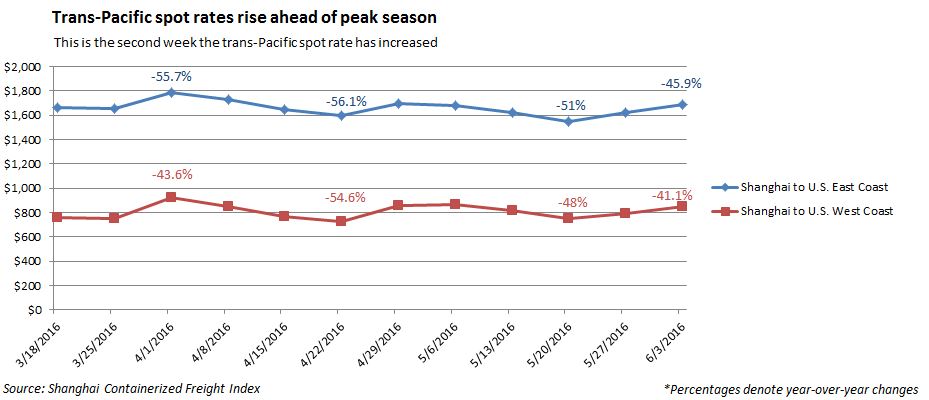
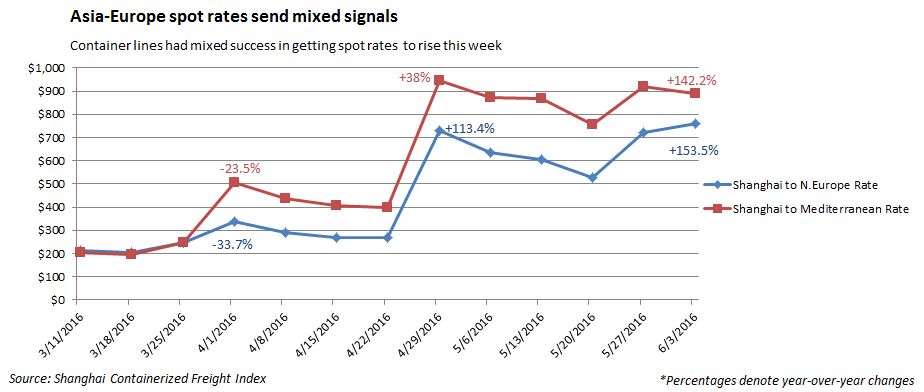
There are tentative signs that the market may be picking up, with freight rates on Asia-North Europe and the trans-Pacific holding on to at least some of the gains from the general rate increases in May and June. Drewry expects the spot rates to hold until after the peak season ends around October.
But after such a long period of low rates, an improvement in the spot market prices might herald bad news for shippers that have locked in cheap rates.
“There are signs that the market is now picking up and prices are increasing, this creates a new risk,” said Berglund. “For shippers that negotiate long-term rates when the market is low there is a danger of rolling cargo, whereby their products are left on the docks to make way for shippers paying higher prices. The resultant loss of sales and supply this incurs is a far more frightening scenario that just paying a few hundred dollars more in rates.”
Berglund said on the Asia-North Europe trade, the market average price for transporting a 40-foot-equivalent unit container has fallen by 45 percent since July 1, 2014. According to the clients Xeneta polled, that has created an environment where price is the way of measuring an incumbent partner. “If they aren’t prepared to offer something that is appropriate and in line with the market, then it’s time to switch carrier,” he said.

While price was top of the carrier-switching list among Xeneta’s contributors — Berglund noted that one client gave his top three reasons as ‘price, price and price’ — for some at least, it was not the sole consideration for switching. Risk management, in terms of supply, was also a factor.
“According to some of our shippers, shifts in trade lanes due to changing customer needs — such as a significant volume increase on one lane and a decrease on another — may result in an inability for an incumbent carrier to provide the requested capacity. If you think of retailers that need to react to changing market demands, it’s imperative that their supply chain is both reliable and flexible. A carrier that can’t meet those criteria is simply too much of a risk.”
Loss of trust was the last of the three reasons for changing carriers, with bad experiences or contractual failures undermining relationships that may otherwise have prospered, Xeneta’s survey found. Again though, price was often a key factor.
Berglund said some container ship carriers priced strategically to win market share, but then a few months into the relationship tried to adjust rates to meet their business requirements. This could be in the form of rolling cargo or simply hiking their prices.
“In such a cut-throat segment, which seems to be in a constant state of flux at present, many of these carriers are fighting to survive,” he said. “So it’s understandable they want to maximize rates wherever possible.
“However, shippers rely, and base their entire operational plans, on the information provided by their suppliers, such as guaranteed capacity, transit time and pricing, so the commitments that are made during the procurement process must be honoured. If they don’t do that, they don’t keep the business.”